Thursday, 14 May 2015

How much do you really know about bees?


There are over 20,000 species of bee found globally and what may surprise you is from that number only seven species of them are what are classed as honeybees furthermore, most colonies that are found consist of one main species in particular Apis mellifera as shown below. The picture above shows a bumblebee a common garden visitor of which they are roughly 250 species and alike honeybees form social structures consisting of a queen and her worker drones; these are often all female which communicate via emitting pheromones (scents) and waggle dancing which aids in directing colony members to new nectar site by a series of waggle like movements, providing the direction in relation to the position of the sun.
However this only describes a small amount of the various types of bees known, what about all the others?


Not everyone lives in hives
Some bees like to live in vegetation such as the bramble home of the species called Ceratina cyanea whilst, leaf cutter bees such as Megachile centuncularis cut circular pieces from leaves to line their nests. Other species of bee like to form nests underground, such as the tawny mining bee (Andrena fulva) or Lasioglossum malachurum who are often found nesting on footpaths. The red mason bee (Osmia
bicornis) found across Europe and Asia excavates holes in bricks in order to build nests, the females have horn like projections on their heads which aid in excavating the holes. A more unusual approach is seen in Osmia bicolor, this species nests in empty snail shells and will cover them with vegetation to camouflage them from predators.


Ceratina cyanea
Megachile centuncularis
Andrena fulva
Lasioglossum malachurum
Osmia bicornis
Osmia bicolor

A specific diet
All adult bees consume nectar, this is because upon reaching adulthood the adult bees only need to meet their energy requirements which nectar suffices just nicely. Bee larvae on the other hand need a source of protein to be able to grow and develop into adult bees therefore, female solitary bees collect pollen and place it with the egg within a nest cell before sealing it.
Some bee species are picky about which flowers they will obtain nectar from for example, Macropis europaea only visits one species of flower called yellow loosestrife; the bee not only collects pollen from the plant but also fatty floral oils, presenting it to the larvae alongside the pollen.Chelostoma campanularum as its name suggests will only visit flowers which belong to the Campanula genus where, the males can be found sleeping in the flowers.

Macropis europaea
Chelostoma campanularum


Sweat bees
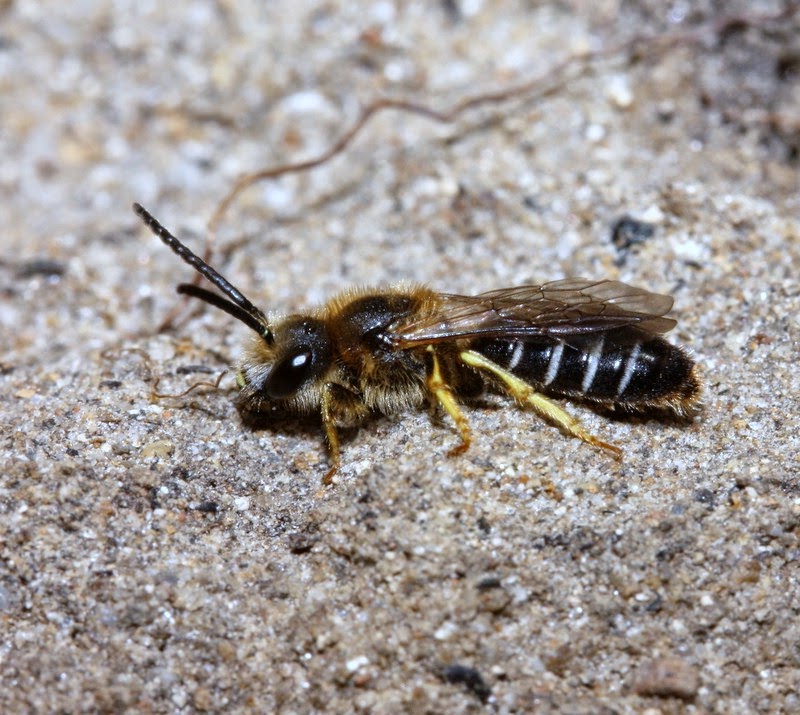
Some bees that are classed as solitary are not living as solitary lives as to be expected and in some parts of the world are known as sweat bees due to the some species appearing to enjoy licking sweat off humans. Some of these species are social whilst others vary between social and solitary lives such as Halictus rubicundus which varies its behavior according to climate, being more social in warmer areas and solitary in colder ones. This group also contains some of the smallest bees in the world and some of the most beautiful, Lasioglossum morio is only 5-6mm in size but has a beautiful metallic green coloration which unfortunately is often overlooked as it looks colorless from afar.
To read the original article click here.
Halictus rubicundus
Lasioglossum morio

I have found a bee in distress what do I do?
I often find a few bees during the warmer months that are on the floor crawling around and appear to be struggling to fly. As bees are currently declining across the UK and other areas of the world I always want to do my part to help get these poor bees back to good health again but how? A very much tried and tested technique that was passed down to me by my grandpa, is to get a little bit of honey and place it near to the bee and then back away and wait (sometimes its quick others it can take a while) the bee benefits from a energy boosting meal and will eventually fly away. Have not got any honey available to use? Agave nectar or even sugared water (2 tablespoons of sugar 1 tablespoon of water) can help to save a stranded bee.

My views
Bees are amazing insects that have adapted to many different ways of living in a variety of environments and with out them flower populations would suffer, as a major pollinator would be no longer available. As humans we rely on them to fertilize our crops/make our gardens beautiful via pollination and to provide us with honey therefore, maybe we should take just a little more time to appreciate and help/encourage bees into our gardens, if you would like to help/encourage more bees to visit your garden here are some helpful tips.


They are also lots of helpful websites with plenty of information available online, such as bumblebee conservation trust which features: identification charts, how you can help and even bumble kids so the younger generation can get involved. To visit the site click here.

As always thank you for taking the time to visit and read my blog, feel free to share your thoughts in the comment box below, perhaps you have some tips on how to encourage bees you may like to share or some other helpful websites. Until next time keep it wild!

Thursday, 23 April 2015

Why did the chimp cross the road? Chimps witnessed using safe crossing techniques


About chimpanzees
The chimpanzee (Pan troglodytes) are found across equatorial Africa ranging across countries such as: Angola, Ghana, Rwanda, Sudan and Uganda where, they occupy a wide range of habitats from savannahs to rainforests to swamp land. Chimpanzees generally lack sexual dimorphism (different looking males and females i.e. male peacocks have plumed tails whilst females lack them.) however, males are slightly larger then females weighing up to 60kg whilst, females weigh up to 47kg and youngsters are born with a white tail tuft which may indicate their age. Chimpanzees can live up to 45 years in the wild and much longer in captivity; they live on a diet that consists mainly of fruits but can be supplemented with various other foods including insects, honey and meat, actively forming hunts to catch species such as duiker (Cephalophus sp.) and the red colobus monkey (Procolobus sp.).


A duiker a common prey species.


What was observed
It is already known that chimpanzees can adapt their behavior depending on the situation, for example during crop raids chimpanzees have learned to change their approach techniques and
vocalizations, to aid in making them less noticeable. More recently however chimpanzees have been seen using safe crossing techniques when crossing a busy road in Kibale National Park in Uganda.

What was Studied
The studied focused on how human highways affected chimp behavior especially, since human overpopulation causes us to further encroach onto their territories. The team of scientists spent two and a half years studying chimpanzees crossing the road at Kibale National Park; in total they saw 122 crossings of the road which experiences a high rate of traffic with up to 60 vehicles per hour, traveling at speeds up to 60mph along the road. 


The results
During each crossing the chimpanzees were vigilant with the majority (more than 90%) looking both ways before they crossed. Upon proceeding to cross over 55% chose to run, further demonstrating that they were aware that they needed to cross quickly to avoid being hit and 20% watched those that were crossing either making sure they were okay or waiting for them to cross. 
Alpha males were always first to cross the road, aiding the rest of the group as they crossed, with males often being the ones that made sure the vulnerable and infants crossed safely.
Lastly when the data collected was compared with that taken from a road that passed through another park in Guinea, they noticed that different techniques were used, with the chimps crossing in pairs at this location. They realized that the road in Guinea was not as busy as the one found in Uganda which led to the chimpanzees adopting different crossing techniques due to the presence of traffic.

My views
This study shows just how intelligent and flexible chimpanzees can be; this is a example of what is referred to as a learned behavior, it has arisen due to the loss of group members during early encounters with the road, this will have led to a individual or group of individuals adopting a more visual, protective response when crossing the road therefore, by checking for oncoming vehicles and that the road was clear before crossing could live to see another day. Other group members will then see that this behavior is beneficial and begin to adopt the technique themselves leading to a new behavioral process being learned. This could also represent a form of critical thinking with the chimpanzees being faced with a problem and them learning how to combat it again showing just how intelligent these creatures are. Another reason why we should learn to respect and appreciate these amazing animals and learn to be able to live alongside them.
As always thanks for reading my blog and feel free to leave any thoughts in the comments box below :)
To view the original article please click here.


Monday, 13 April 2015

Another look at poaching; elephants in trouble.


About the African elephant
The African elephant (Loxodonta africana) are found across the continent of Africa, are the largest land dwelling species at up to 13ft high and can live up to seventy years. Females form herds consisting of related individuals and their young; these groups are led by the oldest female known as the matriarch who uses the knowledge she has collected with age and from previous matriarchs, to lead her family to water and food sources. Male elephants often leave the family group as they begin to mature, leading a solitary life often only seeking out females during musth. The large ears of the African elephant help with regulating heat levels and are often spread during threat displays to try to make them look bigger. Both sexes of this species grow tusks which are used for digging up tubers and other food sources as well as fighting in the males, unfortunately it is these tusks which are putting these incredible animals at risk.

Ivory poaching and conservation
It is well known that species such as elephants are targeted by poachers for their tusks which consist of ivory, a product that brings a high profit price in eastern countries and the constant battle by conservationists to prevent it however, a problem arises on how to fund conservation projects and what may not be known by the general society, is that most of the funds come from legally sourced stockpiled ivory. These stockpiles are taken from elephants that have died natural deaths or from herd management schemes and are kept by various African governments, to be sold to eastern markets that deal in legally sourced ivory though, it is worth noting that some governments have burnt their stockpiles due to increased pressure by confused parties as to where the legal ivory is taken from.

 
Corruption within legal ivory trading
A problem has recently been revealed within the legal ivory trade in which park staff, custom officials and government officials have been corrupted and allowed poached ivory to be traded as legal ivory. A study in 2010 which investigated how well Africa's parks protected its wildlife, revealed that in countries where corruption occurred i.e.paying of police to turn a blind eye to poaching, all species of animal were in decline.

How to tackle the problem
The main focus needs to be on preventing corruption by making it a more prominent issue in conservation planning, this means changing how conservationists view the issue and therefore how they approach it. For example just enforcing new policies such as strict penalties and throwing more money into the schemes because this only seems to play into the hands of corrupt systems i.e. further encouraging redirection of money flow or, burning of stockpiled legal ivory in case it may contain illegal items which will only cause the value of ivory to increase, increasing the likelihood of poaching. Conservationists need to better understand the reasons behind why corruption occurs and turn to other countries that have been successful in dealing with scenarios such as this and then they will be ready to address this issue effectively.
To read the original article click here.


My Views
I chose this article due to its similarities to a book that I just finished reading called animals on the edge by Chris Weston which highlights the many animals across the globe that face extinction. It also features some very interesting case files which give a opportunity for the people who are loggers, poachers etc, to explain just why they do what they do. One that particularly stood out to me was an account taken from a man who was caught poaching in a park in India, I will not lie and say that upon beginning to read this case I was a bit biased towards his views but by the end I was very much enlightened, here is a brief overview of his story; he came from a poverty stricken area, with no money to feed his family. He awoke one day to find that his youngest son had died overnight from disease which caused him to hit rock bottom, it was at this point that he wanted better for himself and his family and no longer wanted to experience the loss of his children. It was with this mind that he sought out a man that he was told could bring you and your family great wealth and take him away from this life. It did not take him long to find the man responsible, he was well dressed and filled the man's head with glamorous tales of a better life, he also told the man that the money came from poaching and convinced him that they were not endangered and that if he was caught he would not get into trouble and he would help him out. Of course the man was taken in by this and was soon caught trying to poach animals within a state park and is now facing 40 years in jail which due to the conditions he may not even survive, he is just 23!
Some of you may still think he got what he deserved but the truth is that many of these people including the man just mentioned, do not want to kill animals or destroy acres of forest, they do it to survive often because corrupt countries have taken away their livelihoods and often sustainable methods of living to replace them with unsustainable money earners such as logging, providing these people with their only chance at a source of income. Therefore I agree with what the article is saying, that we need to change how we approach conservation and adapt a method that benefits not just the wildlife but the people who live alongside them. Only when these people can be provided with a secure source of income other then poaching/logging via projects such as ecotourism which has proved to be a success in many areas, can we truly start to preserve species and the habitats they live in.


As always feel free to add your thoughts or comments in the box below and thanks for reading :)
If you would like a copy of animals on edge, you can purchase it by clicking here.

Thursday, 2 April 2015

A problem for the poor pangolin


What is it?
The pangolin (Manis sp.) can be described as Africa and Asia's version of the American armadillo (Dasypus sp.) and therefore an example of what is known as convergent evolution or where two animals develop similar traits in response to similar environmental needs despite, being miles apart. It is covered in scales that are comprised of keratin, the same material as can be found in your fingernails and is the only mammal species to do so; when a potential predator approaches the pangolin wraps itself into a ball like position, protecting itself from harm however, if this fails to deter the predator the pangolin has yet another method of defense, it can spray a foul smelling acid to rid itself of the predator threat.
The uniqueness of the pangolin has earned them a placement in their own order pholidota, all are nocturnal living solitary lives and feed on ants and termites using their long tongues to collect them.
Pangolins are also great mothers who carry their babies called pangopups, on their tails for the first two months of their lives, after which they continue to stay with mum for a further two years till they reach adulthood. 


The pangolin's problem
Most species of pangolin are endangered with two Asian species being recently changed to critically endangered, this is due to over 100,000 pangolins being illegally poached every year to be used in the trade of pangolin meat. The meat can fetch up to £168.00 per kilo and is seen as a status symbol product in countries such as Vietnam and China; a popular dish is pangolin fetus soup which is used to aid various symptoms from virility in men to breastfeeding in women. Scales are also highly prized and are believed to aid in curing both mild symptoms to serious medical conditions such as cancer.

  
There is of course no scientific evidence to suggest that consuming any of these food items results in the desired effect and the belief in them providing these benefits probably comes from the Chinese meaning of the pangolins name meaning one that can dig through a hill; leading to consumerists believing that they will be instilled with this strength by eating them.

How we can help
Reducing the need for pangolin meat and scales is the obvious first step in protecting pangolins from extinction and therefore awareness campaigns are a good start and have worked for other delicacies such as shark fin soup and whale meat which have seen declines in trade since awareness campaigns started.
Addressing the illegal trade of the species within China and Vietnam and enforcing stricter penalties for those caught poaching and selling pangolin meat however, as with any conservation effort it requires funding to make it happen and the only way funding can occur is by making the nation more aware of the pangolin's plight and how much of a loss it would be to lose this amazingly unique creature forever.
The recently developed pangolin specialist group website is a good place to visit if you would like to learn more about the pangolin and the conservation efforts being undertaken to help it, the site is run by dedicated researches and also offers the option for people to get involved or if they so wish to donate to the cause. To view the website please click here.


My views
I have to start by saying and please remember this is purely my opinion on the matter, that is continues to surprise me that countries such as China and Japan that are so developed in ways such as technology but can be and I shall try to pick my words carefully, underdeveloped in this aspect. I struggle to understand how people who have the cognitive ability to develop leading technologies can fall foul of unfounded traditional beliefs that clearly carry no medical benefit for the consumer. Now I understand that there is the argument that in the UK people eat meat and that it can vary from cows, to deer but all these animals are not taken from wild populations and are being consumed on the basis of the simple fact that we are omnivorous and therefore require a diet that includes meat as part of a healthy diet not because we believe that we will gain some unrealistic medical gain such as higher fertility or a cure for cancer. It is therefore a shame that such a wonderful species is facing extinction not due to habitat loss but alike species such as the tiger, rhinoceros and elephant, due to human ignorance and unwillingness to accept that their beliefs are unfounded and ever more outdated in a population that is overflowing with bright minds and great technology.
As always thanks for taking the time to read my blog and feel free to add your own thoughts in the comments box below :).

Thursday, 26 March 2015

Does the evidence from a new study suggest that Burmese pythons are responsible for native species deaths in Florida's Everglades


Building upon the topic of my last post, it has now been suggested via a year long study that Burmese pythons (Python molurus bivittatus) are responsible for the death of native species within the Florida Everglades.

What they did
A team led by Robert Francis of the University of Florida captured native marsh rabbits (Sylvilagus palustris), fitting a total of 95 trackers to adults that included a mortality sensor which notified them of the animals death. The rabbits were then released onto three separate sites, two sites had pythons present whilst the third had no observed pythons present. The team stated that they chose marsh rabbits for the study due to their prolific breeding habits suggesting, that it would be harder to wipe such a species out.
The rabbits were radio tracked at least once every two days and any carcasses found were examined for cause of death; predation by either the python or alligators was easy to detect as it was often still located within the body of the animal. Two carcasses which were found were also tested for traces of python DNA.

What they found
Once the year long study had been completed, the findings showed that only two rabbits had survived, with the team documenting a total of 68 rabbit deaths (If like me you are wondering what happened to the other 25 rabbits which were tracked to make up the total of 95, it does not mention them so unfortunately I can not provide an accurate answer other then to guess that they were not retrieved). In the areas of the park where pythons were present it showed that they were responsible for 75% of the deaths compared to 71% in areas where they were not present which, were were caused by mammalian predators, leading them to suggest that the pythons were the main threat for the species decline.


My Views
Firstly I am drawn to the conclusion made by this study, how can it suggest that the python is any more of a threat to the species when the two percentages are so similar? Surely all this data would suggest is that where pythons are present they are the new apex predator and therefore are out competing other native mammals for the same food source meaning, that the python is more of a threat to the native predators which it out-competes, then to the marsh rabbit which it preys upon as, the rabbit is still preyed heavily upon by mammalian species where the python is not present.
Secondly this study is again being used as a reason to back Americas reasoning that exotic species such as the Burmese python should be banned from ownership but again alike a lot of the studies that supposedly support this theory there is often plenty of misinterpretations that are too questionable to allow these studies to be used as evidence. I agree that the pythons are a invasive species and should be removed from the area but I do not agree that it should result in a ban of a species as a result; over the years thousands of domestic species such as livestock i.e. pigs and goats and dogs and cats have escaped and become feral across America and the rest of the world and not once have I heard of any of these countries banning the ownership, or importation of any of these species; it seems that because there is so much stipulation and poor education about exotic species such as reptiles and snakes that they become an easy target for eradication but they are many reptile owners out there who love and care for there bearded dragon, corn snake or Burmese python as much as any cat or dog, rabbit or guinea pig owner loves their pet, they are part of their family just as much and I only hope that with a bit of education and understanding it will be that way for many more years to come.

 
As always thanks for taking the time to visit and read my blog and if you would like to share your opinions then feel free to add them in the comments box below :)
To view the original paper click here 

Sunday, 8 March 2015

A dark day for the reptile community. Four new snake species added to the Lacey Act

Reticulated Python, one of the new species added to the Lacey Act.


On the 6th of March the United States Fish and Wildlife service announced that four species of large snake are to be added to the Lacey Act; these are the reticulated python (Python reticulatus) and three species of anaconda, the DeSchauensee’s anaconda (Eunectes deschauenseei), green anaconda (E. murinus) and beni anaconda (Eunectes beniensis) which join the Burmese python (Python bivittatus) which is already on the act.

So what is the Lacey Act?
The Lacey Act was passed in 1900 to aid in protecting wildlife by inflicting strict penalties on anyone trading animals and plants illegally and regulates the import of any species protected by international or domestic law and thus prevents the spread of non-native/invasive species. For more information about the act please click here for the US fish and wildlife service official explanation of the act.

So why are these snake species being added?
The Burmese python was originally added to the Lacey Act as a result of the spread of a invasive population that had been released by suspected pet owners, who could no longer manage them, in the Florida everglades. These snakes have had a supposed detrimental effect on the local wildlife populations, by preying on species such as birds and some endangered species. It is interesting to note however that local residents from the everglades state that most have never seen a Burmese in the everglades and that other invasive species such as stray cats and pigs are more prevalent and have more of a negative effect.
The four latest additions are not actually found as an invasive species anywhere within the United States and have been put on the act as a precautionary measure suggesting, that they might become an invasive species in the future; a interesting view on this was provided by Brian Barczyk from BHB reptiles and who runs the popular online show animal bytes, he stated 'it is like putting someone in jail because they might commit a crime.'. None of these snakes could survive in the wild in northern states due to the cold climate and therefore could never become an invasive species, this poses the question of why should the entire population of reptile owners be punished for a incident that has only occurred in southern Florida? and why are other more invasive species such as stray cats and pigs not included on the list for the same reasons?

The green anaconda another addition to the act.

So how does this effect me?
If you live in the United States and own one of these five species, you can still keep them and if you wish breed them but you can not cross state lines with them or you would be breaking the law which, carries a sentence of up to five years in prison if they press charges. This means that if you had to move between states then your snake can not come with you, leaving you with the option of staying put, trying to re-home the snake or the one that no pet owner should ever have to face, euthanizing a healthy animal because of a misjudged law.

I do not live in America, how does this affect me?
Unfortunately it is only too common that once one country adopts a policy like this, that others start to follow and already within the UK, the announcement that the Scottish government wants to review its exotic pet trade act, could result in not just the prevention of keeping snakes but also other reptiles, fish, small mammals and birds.

So what can I do to help prevent/fight against this?
In the US the USArk has filed a federal lawsuit against the US fish and wildlife service for their use of poor reasoning for why this law has been passed. To find out more about USArk and to find out how you can help in the fight against the Lacey Act please click here  to view their site.
For UK residents a petition has been started by the Federation of British Herpetologists against the Scottish government, to sign the petition please click here and to find out more about it please click here to visit their website.

Finally I shall leave you with a video by Brian Barczyk owner of BHB reptiles, the animal bytes online video show and who is passionate about educating people about reptiles, having helped myself and friends with our own snake questions as well as providing breeding advice. This video discusses the Lacey Act and the effects it will have on the reptile community which brought tears to my eyes.


Sunday, 1 March 2015

Reciprocating rats! Rats more willing to help those that help them.


Humans are familiar with the concept of returning a favor if someone has helped them, this is known as reciprocity and is a favorite explanation for how co-operative behaviors evolved. In nature this behavior is difficult to study, this could be due to it being rarer then thought in nature or because it is a behavior that is difficult to measure in the field.
A study by Dolivo and Taborksy looking at Norwegian lab rats (Rattus norvegicus) found that the rats give as good as they get. Following the principle that this behavior is hard to study in the wild and therefore using a controlled laboratory environment instead; they trained the rats to pull a stick that issued food items to a rat in a adjourning cage which could see the the rat dispensing the treat through the cage. They then expanded on this by placing a rat in between two cages containing rats on either side. The cage on the left had a stick that upon being pulled dispensed a carrot treat to the central rat whilst, the cage on the right had a stick that dispensed a banana treat to the central rat. The central rats generally favored the banana treat therefore, this would suggest that the central rat would favor the right side rat that dispensed the banana treat and would be more willing to help banana providing rats than carrot providing ones; this turned out to be true with rats that provided better help (banana) receiving greater rewards as a result, indicating reciprocal behavior.

 
These results therefore clearly show that rats have the ability to recall not only which rat helped them but the quality of help received as well, adjusting their behavior accordingly as a response. Adding this onto previously studies undertaken by Taborksy's team that rats are more likely to help a partner that has aided them before compared to one that had not; it provides a interesting insight into how a species manages the challenges of co-operation.
However it is not just rats that have displayed the ability to reciprocate, a study by Melis et al (2006) demonstrated how chimps theorized which partners to choose, based on previous experiences, when embarking on tasks. It has also been seen with fish that use cleaner fish, these client fish as they are often referred as, will often favor cleaner fish that behave in a more co-operative manner. Lastly even pied flycatchers have been observed favoring other flycatchers that actively aid them in mobbing owls in their territories.


All these examples clearly show that reciprocation is used within the natural world as, it provides a benefit to both animals involved and that those who help more will receive more in return; this behavior possibly aids in forming stronger bonds amongst social groups allowing those who aid the group to be favored over those that do not.
To view the original article Click here. 
Thanks for reading and as always feel free to leave any additional views or comments in the box below :)