Friday, 26 June 2015

Why parrots can copy sounds and 'dance' along to music.

Blue and yellow macaw (Ara ararauna)

About parrots
They are roughly 372 species of parrot (Psittacines) found worldwide and are categorized into three super-families, Psittacoidea (True parrots), Cacatuoidea (Cockatoos) and Strigopoidea (New Zealand parrots). Parrots are found in the majority of tropical and subtropical regions of the world with, the greatest diversity being found in South America and Australasia. 
Most parrots eat a diet consisting of seeds, nuts and fruit but some species eat carrion and others such as lorikeets feed on nectar from flowers. 
They are among some of the most intelligent bird species found on the planet, a feature that makes them popular as pets unfortunately, this leads to illegal trapping of the species in the wild which has an impact on species numbers, resulting in some species becoming endangered in the wild.

Rainbow lorikeet (Trichoglossus moluccanus)

Why parrots can imitate sounds
Parrots are among the few species that can imitate another species sound and a new study has identified the area of the brain that may be the reason that allows this to occur. 
All birds that sing have areas in the brain that enables the singing ability known as cores but in parrots they are also outer rings called shells. To discover how this shell system functions, a team of scientists focused on gene expression (The process in which information from a gene is used to form a functional gene product) of nine species of parrot.
The study found that parrots have a complex pattern of gene expression in all three parts of their brains, meaning that most of the vocal capabilities of parrots is due to the presence of the shells, this came as a surprise to the scientists as it was previously thought that the shells had no connection to speech. However, it was noted that future research is needed to further examine the exact methods of how imitation is achieved.
The fact that shells were present in the most ancient species of parrot the keas, suggests that these vocalization abilities occurred over 29 million years ago or around the time our ancestors separated from our primate cousins. 
Learning to imitate sounds is not a simple process and requires the ability to recognize musical information, process it and reproduce it which, requires a lot of brain power. Fortunately the shell system in parrots enable these processes to occur allowing the parrot to reproduce sounds.

Kea (Nestor notabilis)

All in the groove
Parrots are also one of the few animals that are able to dance along to the beats of a piece of music. Dancing in parrots is associated with non vocal areas of the shells, supporting the possibility of learning sounds and matching that with their behavior. 
To view the original article please click this link.

As always thanks for taking the time to visit and read my blog, feel free to share any thoughts/comments in the box below and until next time keep it wild!!!!!


Tuesday, 9 June 2015

There is a reason they issue warnings! Bison attack tourists in Yellowstone.


About bison
As many as 30 million bison (Bison bison) used to roam the plains of North America, unfortunately this had dropped to 1091 in 1889 due to habitat loss and unregulated shooting, numbers have grown since then and now numbers of 500,000 are recorded. Bison can live up to 22 years in the wild, reaching a height of between 6-6.5ft with males weighing up to 2000lbs and can charge at speeds up to 30mph. They are herbivores living on a diet of grasses, constantly roaming in herds consisting of females and young (males only join during breeding). The great plains of America often has severe weather fluctuations with hot summers and freezing winters, the bison combat this forming wallows during hotter periods and forming a thick coat during winter, this coat is so thick that snow can settle on it and not melt.


About Yellowstone National Park
Yellowstone was first established as a national park in 1872 to help protect its famous geysers such as Old Faithful, it is located mainly in Wyoming but also extends into neighboring Montana and Idaho spanning a total of 3,468.4sq miles. It is home to Yellowstone lake one of the largest high elevation lakes in America, this sits upon the Yellowstone caldera the largest super-volcano on the continent! This volcano is still active and is what fuels the many geothermal vents in the area. Yellowstone is also the home of many species of animal several of which are endangered or threatened, these include the grizzly bear, elk, wolves and of course the bison, the herd that roams here is the oldest/largest public bison herd in America.
To discover more about Yellowstone National Park please click here to visit their webpage.


What happened?
Every day at Yellowstone National Park rangers issue leaflets notifying the public of the dangers of visiting the park, the warnings are very straightforward for example: do not shout near animals or run towards them. One leaflet even goes as far as featuring a man being gored by a bison and telling visitors to maintain a distance of at least 72 feet from them. Yet these warnings appear to still fail to get people to act appropriately as two people have been injured by bison at Yellowstone within three weeks!
The first person who decided not to heed the warnings, was a 62 year old Australian man who was tossed several times into the air by a bison. Rangers from the park noted that a crowd had formed around the bison getting as close as 5 feet away! Upon proceeding to take photos the bison charged at the man tossing him into the air with its horns, the man was taken to hospital where he was treated and released later the same day.
The second incident involved a 16 year old Taiwanese girl who again did not heed warnings and got too close to a bison to pose for a photo, again she was taken to a hospital with serious injuries.
 A spokesperson for the park mentioned how people forget that the animals are wild and will behave as such stating that 'the temptation is there when the bison looks calm'.
More and more people visit Yellowstone National Park every year and it is incidents like this that force the park ranger to have to protect wildlife and police tourists which is why warnings are so frequently issued, the problem is that people continue to ignore them.


My Views
I feel ever more constantly that we are becoming a society which firmly believes that in scenarios where serious injury could happen, that we think it won't happen to us and this is why incidents like this occur so frequently. It does not even have to be animal related, for example imagine a person in a car, their mobile phone just went off with a message, now we all know what we should do which is either pullover in a safe place or wait till you arrive at your destination to read the message but maybe this person has texted and drove before and was fine or perhaps they have not done it before but the road is not busy and they know what they are doing (it won't happen to me) and then in that moment whilst they are distracted a kid runs out and the inevitable happens. We all faced with a multitude of warnings every day and most are probably ones that are not all that significant in our daily lives but those like the ones featured here that affect not only yourself but others too and carry a potential high risk factor should always be heeded, it may not happen to you but what if it did? These incidents often carry serious injury or death, what happens when you sustain major fractures and can't work or worse if you died? Nearly every day I read in the news about someone who was killed/seriously hurt driving irresponsibly or in an animal attack and what annoys me is that they could all be avoided if common sense prevailed.
It is important to remember whenever you visit an area where animals are wild to treat them with respect and maintain a safe distance from them, if you want a close up shot then buy a camera with a telescopic lens that will allow you to zoom in and take that great photo whilst staying safe and if you want that selfie how about with a statue or model instead? At least you will be walking away with a set of pictures that you can share with family and friends, instead of a broken camera and spending your holiday in a hospital or worse not coming home at all.

As always thanks for taking the time to read my blog, please share any of your thoughts in the comments section below and until next time keep it wild!!!!!


Friday, 22 May 2015

To turn or not to turn? That is the question, as abilty to change mosquito sex is discovered.


About mosquitoes
Mosquitoes belong to the family Culicidae and contrary to popular belief not all species are harmful to us furthermore, it is only the females of most species that are harmful, possessing a proboscis (tube like mouth parts) to pierce the skin and obtain blood. Death never occurs in any host from blood loss but the saliva from the mosquito often causes a irritating rash to develop around the bite. The real problem with receiving a mosquito bite is that they act as carriers or vectors for serious diseases such as dengue which occurs in sub tropical areas and causes severe flu like symptoms and only in severe instances causes death, west Nile virus which most commonly shows no symptoms of the disease but when it does flu like symptoms occur, with less then 1% of cases becoming life threatening and yellow fever which only affects humans and primates causing an initial outbreak of fever, loss of appetite and muscle pain and headaches. This will improve after a few days but occasionally the disease returns with abdominal pains and liver damage causing the skin to become yellow. The person will start to bleed internally causing them to vomit blood with 20% of people who experience this stage loosing their life to the disease, though it is worth considering that in general only 3% of people in general die from this disease.


What the study found
As mentioned previously it is only the females that pose a threat therefore, scientists have tried to find a way to genetically change females into males to render them harmless. This is a difficult process due to insects having a genome in which, it is difficult to identify single genes within the Y chromosome (the chromosome which dictates that a male be formed i.e. if a baby has to XX chromosomes it is a girl but if it is XY it is a boy) however, whilst analyzing male Aedes aegypti DNA a team of scientists from Virginia Tech led by Zach Adelman  and Zhijian Tu, found a candidate gene called M factor Nix (M factor = male determining gene) that was expressed (A genetic instruction often a protein which aids in the formation of hormones, enzymes etc) in both adult males and developing embryos. They used a gene editing tool to control how this gene was expressed, allowing them to discover that it was needed to start male development.
Changes to this particular gene caused substantial deformities to male sex organs and when they silenced (stop the gene from being able to perform its function) the gene, the males lost certain features of their genitalia and when the gene was expressed on other areas of the genome (the name for where all the animals genetic material is stored such as DNA) it caused mutant females to have masculine genitalia.

An example of a mosquito species life cycle.

What these findings mean
The discovery that this particular gene could essentially become an important factor in preventing mosquito borne diseases. This is because when female embryos were injected with this gene they developed male genitalia suggesting that it may be a future possibility to change harmful females into potentially harmless males.
To view the original article click here

My Views 
Initially you may think this sounds like a brilliant discovery and a big step forward in the eradication of harmful diseases within the human race but the question that needs to be asked here is where should the line be drawn between what can be classed as science and when we start to play 'god'? Firstly lets examine what the health benefit to this actually would be. We would all love to live in a world where disease no longer exists and this is a tiny step closer to this but is it really? We created what was classed as the wonder drug penicillin (antibiotics) used it to treat lots of various diseases and now? We are finding that it no longer is as effective as most viruses have evolved their genetics to become resistant to it, putting the world at more risk of fatal epidemics occurring. Is this any different? What if we do eradicate the disease carriers from this particular mosquito species, they still are other species that could potentially fill the gap. How do we know that this species prevents another that could be more deadly to us from becoming more common from out competing them? How do we know what impact the loss of this species would cause? We can not say for certain that a particular type of animal may rely heavily on this species as its main source of food. Many may argue that they are plenty of other species of mosquito present within the same environment but consider it like this, even the slightest of touches on the surface of a pond causes a ripple effect to occur therefore, even though this species may seem insignificant, like everything in nature it does serve a purpose and what ever that purpose may be it most certainly won't be insignificant to those that are part of that purpose.
To me this finding only creates more questions then answers therefore, I firmly believe that a lot more research is required before this could be classed as a truly viable method of disease eradication. 

What do you think? Is this a positive or negative area of research to pursue? Leave your comments in the box below and as always thanks for visiting and reading my blog, until next time keep it wild! 

Thursday, 14 May 2015

How much do you really know about bees?


There are over 20,000 species of bee found globally and what may surprise you is from that number only seven species of them are what are classed as honeybees furthermore, most colonies that are found consist of one main species in particular Apis mellifera as shown below. The picture above shows a bumblebee a common garden visitor of which they are roughly 250 species and alike honeybees form social structures consisting of a queen and her worker drones; these are often all female which communicate via emitting pheromones (scents) and waggle dancing which aids in directing colony members to new nectar site by a series of waggle like movements, providing the direction in relation to the position of the sun.
However this only describes a small amount of the various types of bees known, what about all the others?


Not everyone lives in hives
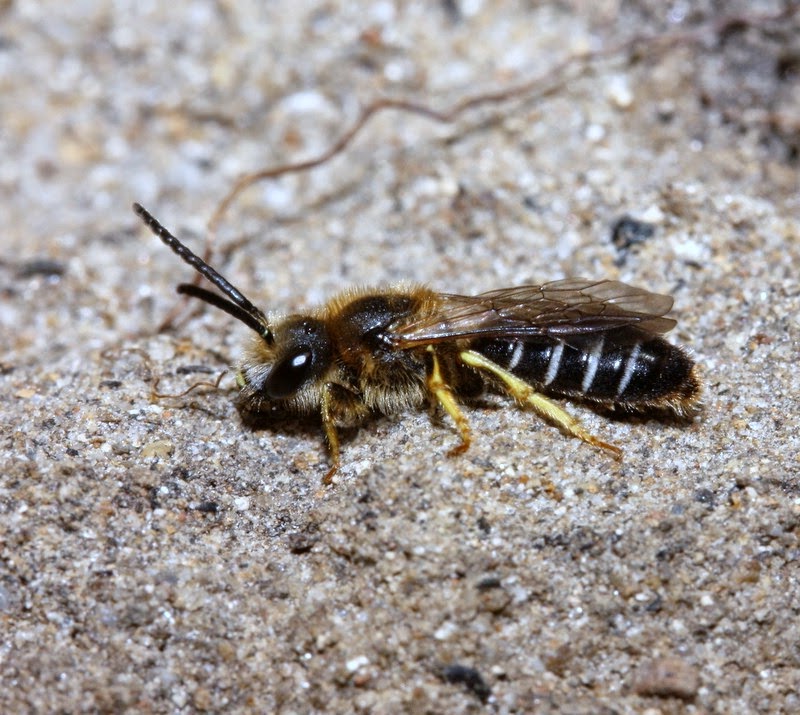
Some bees like to live in vegetation such as the bramble home of the species called Ceratina cyanea whilst, leaf cutter bees such as Megachile centuncularis cut circular pieces from leaves to line their nests. Other species of bee like to form nests underground, such as the tawny mining bee (Andrena fulva) or Lasioglossum malachurum who are often found nesting on footpaths. The red mason bee (Osmia
bicornis) found across Europe and Asia excavates holes in bricks in order to build nests, the females have horn like projections on their heads which aid in excavating the holes. A more unusual approach is seen in Osmia bicolor, this species nests in empty snail shells and will cover them with vegetation to camouflage them from predators.


Ceratina cyanea
Megachile centuncularis
Andrena fulva
Lasioglossum malachurum
Osmia bicornis
Osmia bicolor

A specific diet
All adult bees consume nectar, this is because upon reaching adulthood the adult bees only need to meet their energy requirements which nectar suffices just nicely. Bee larvae on the other hand need a source of protein to be able to grow and develop into adult bees therefore, female solitary bees collect pollen and place it with the egg within a nest cell before sealing it.
Some bee species are picky about which flowers they will obtain nectar from for example, Macropis europaea only visits one species of flower called yellow loosestrife; the bee not only collects pollen from the plant but also fatty floral oils, presenting it to the larvae alongside the pollen.Chelostoma campanularum as its name suggests will only visit flowers which belong to the Campanula genus where, the males can be found sleeping in the flowers.

Macropis europaea
Chelostoma campanularum


Sweat bees
Some bees that are classed as solitary are not living as solitary lives as to be expected and in some parts of the world are known as sweat bees due to the some species appearing to enjoy licking sweat off humans. Some of these species are social whilst others vary between social and solitary lives such as Halictus rubicundus which varies its behavior according to climate, being more social in warmer areas and solitary in colder ones. This group also contains some of the smallest bees in the world and some of the most beautiful, Lasioglossum morio is only 5-6mm in size but has a beautiful metallic green coloration which unfortunately is often overlooked as it looks colorless from afar.
To read the original article click here.

Halictus rubicundus
Lasioglossum morio

I have found a bee in distress what do I do?
I often find a few bees during the warmer months that are on the floor crawling around and appear to be struggling to fly. As bees are currently declining across the UK and other areas of the world I always want to do my part to help get these poor bees back to good health again but how? A very much tried and tested technique that was passed down to me by my grandpa, is to get a little bit of honey and place it near to the bee and then back away and wait (sometimes its quick others it can take a while) the bee benefits from a energy boosting meal and will eventually fly away. Have not got any honey available to use? Agave nectar or even sugared water (2 tablespoons of sugar 1 tablespoon of water) can help to save a stranded bee.

My views
Bees are amazing insects that have adapted to many different ways of living in a variety of environments and with out them flower populations would suffer, as a major pollinator would be no longer available. As humans we rely on them to fertilize our crops/make our gardens beautiful via pollination and to provide us with honey therefore, maybe we should take just a little more time to appreciate and help/encourage bees into our gardens, if you would like to help/encourage more bees to visit your garden here are some helpful tips.


They are also lots of helpful websites with plenty of information available online, such as bumblebee conservation trust which features: identification charts, how you can help and even bumble kids so the younger generation can get involved. To visit the site click here.

As always thank you for taking the time to visit and read my blog, feel free to share your thoughts in the comment box below, perhaps you have some tips on how to encourage bees you may like to share or some other helpful websites. Until next time keep it wild!

Thursday, 23 April 2015

Why did the chimp cross the road? Chimps witnessed using safe crossing techniques


About chimpanzees
The chimpanzee (Pan troglodytes) are found across equatorial Africa ranging across countries such as: Angola, Ghana, Rwanda, Sudan and Uganda where, they occupy a wide range of habitats from savannahs to rainforests to swamp land. Chimpanzees generally lack sexual dimorphism (different looking males and females i.e. male peacocks have plumed tails whilst females lack them.) however, males are slightly larger then females weighing up to 60kg whilst, females weigh up to 47kg and youngsters are born with a white tail tuft which may indicate their age. Chimpanzees can live up to 45 years in the wild and much longer in captivity; they live on a diet that consists mainly of fruits but can be supplemented with various other foods including insects, honey and meat, actively forming hunts to catch species such as duiker (Cephalophus sp.) and the red colobus monkey (Procolobus sp.).


A duiker a common prey species.


What was observed
It is already known that chimpanzees can adapt their behavior depending on the situation, for example during crop raids chimpanzees have learned to change their approach techniques and
vocalizations, to aid in making them less noticeable. More recently however chimpanzees have been seen using safe crossing techniques when crossing a busy road in Kibale National Park in Uganda.

What was Studied
The studied focused on how human highways affected chimp behavior especially, since human overpopulation causes us to further encroach onto their territories. The team of scientists spent two and a half years studying chimpanzees crossing the road at Kibale National Park; in total they saw 122 crossings of the road which experiences a high rate of traffic with up to 60 vehicles per hour, traveling at speeds up to 60mph along the road. 


The results
During each crossing the chimpanzees were vigilant with the majority (more than 90%) looking both ways before they crossed. Upon proceeding to cross over 55% chose to run, further demonstrating that they were aware that they needed to cross quickly to avoid being hit and 20% watched those that were crossing either making sure they were okay or waiting for them to cross. 
Alpha males were always first to cross the road, aiding the rest of the group as they crossed, with males often being the ones that made sure the vulnerable and infants crossed safely.
Lastly when the data collected was compared with that taken from a road that passed through another park in Guinea, they noticed that different techniques were used, with the chimps crossing in pairs at this location. They realized that the road in Guinea was not as busy as the one found in Uganda which led to the chimpanzees adopting different crossing techniques due to the presence of traffic.

My views
This study shows just how intelligent and flexible chimpanzees can be; this is a example of what is referred to as a learned behavior, it has arisen due to the loss of group members during early encounters with the road, this will have led to a individual or group of individuals adopting a more visual, protective response when crossing the road therefore, by checking for oncoming vehicles and that the road was clear before crossing could live to see another day. Other group members will then see that this behavior is beneficial and begin to adopt the technique themselves leading to a new behavioral process being learned. This could also represent a form of critical thinking with the chimpanzees being faced with a problem and them learning how to combat it again showing just how intelligent these creatures are. Another reason why we should learn to respect and appreciate these amazing animals and learn to be able to live alongside them.
As always thanks for reading my blog and feel free to leave any thoughts in the comments box below :)
To view the original article please click here.


Monday, 13 April 2015

Another look at poaching; elephants in trouble.


About the African elephant
The African elephant (Loxodonta africana) are found across the continent of Africa, are the largest land dwelling species at up to 13ft high and can live up to seventy years. Females form herds consisting of related individuals and their young; these groups are led by the oldest female known as the matriarch who uses the knowledge she has collected with age and from previous matriarchs, to lead her family to water and food sources. Male elephants often leave the family group as they begin to mature, leading a solitary life often only seeking out females during musth. The large ears of the African elephant help with regulating heat levels and are often spread during threat displays to try to make them look bigger. Both sexes of this species grow tusks which are used for digging up tubers and other food sources as well as fighting in the males, unfortunately it is these tusks which are putting these incredible animals at risk.

Ivory poaching and conservation
It is well known that species such as elephants are targeted by poachers for their tusks which consist of ivory, a product that brings a high profit price in eastern countries and the constant battle by conservationists to prevent it however, a problem arises on how to fund conservation projects and what may not be known by the general society, is that most of the funds come from legally sourced stockpiled ivory. These stockpiles are taken from elephants that have died natural deaths or from herd management schemes and are kept by various African governments, to be sold to eastern markets that deal in legally sourced ivory though, it is worth noting that some governments have burnt their stockpiles due to increased pressure by confused parties as to where the legal ivory is taken from.

 
Corruption within legal ivory trading
A problem has recently been revealed within the legal ivory trade in which park staff, custom officials and government officials have been corrupted and allowed poached ivory to be traded as legal ivory. A study in 2010 which investigated how well Africa's parks protected its wildlife, revealed that in countries where corruption occurred i.e.paying of police to turn a blind eye to poaching, all species of animal were in decline.

How to tackle the problem
The main focus needs to be on preventing corruption by making it a more prominent issue in conservation planning, this means changing how conservationists view the issue and therefore how they approach it. For example just enforcing new policies such as strict penalties and throwing more money into the schemes because this only seems to play into the hands of corrupt systems i.e. further encouraging redirection of money flow or, burning of stockpiled legal ivory in case it may contain illegal items which will only cause the value of ivory to increase, increasing the likelihood of poaching. Conservationists need to better understand the reasons behind why corruption occurs and turn to other countries that have been successful in dealing with scenarios such as this and then they will be ready to address this issue effectively.
To read the original article click here.


My Views
I chose this article due to its similarities to a book that I just finished reading called animals on the edge by Chris Weston which highlights the many animals across the globe that face extinction. It also features some very interesting case files which give a opportunity for the people who are loggers, poachers etc, to explain just why they do what they do. One that particularly stood out to me was an account taken from a man who was caught poaching in a park in India, I will not lie and say that upon beginning to read this case I was a bit biased towards his views but by the end I was very much enlightened, here is a brief overview of his story; he came from a poverty stricken area, with no money to feed his family. He awoke one day to find that his youngest son had died overnight from disease which caused him to hit rock bottom, it was at this point that he wanted better for himself and his family and no longer wanted to experience the loss of his children. It was with this mind that he sought out a man that he was told could bring you and your family great wealth and take him away from this life. It did not take him long to find the man responsible, he was well dressed and filled the man's head with glamorous tales of a better life, he also told the man that the money came from poaching and convinced him that they were not endangered and that if he was caught he would not get into trouble and he would help him out. Of course the man was taken in by this and was soon caught trying to poach animals within a state park and is now facing 40 years in jail which due to the conditions he may not even survive, he is just 23!
Some of you may still think he got what he deserved but the truth is that many of these people including the man just mentioned, do not want to kill animals or destroy acres of forest, they do it to survive often because corrupt countries have taken away their livelihoods and often sustainable methods of living to replace them with unsustainable money earners such as logging, providing these people with their only chance at a source of income. Therefore I agree with what the article is saying, that we need to change how we approach conservation and adapt a method that benefits not just the wildlife but the people who live alongside them. Only when these people can be provided with a secure source of income other then poaching/logging via projects such as ecotourism which has proved to be a success in many areas, can we truly start to preserve species and the habitats they live in.


As always feel free to add your thoughts or comments in the box below and thanks for reading :)
If you would like a copy of animals on edge, you can purchase it by clicking here.

Thursday, 2 April 2015

A problem for the poor pangolin


What is it?
The pangolin (Manis sp.) can be described as Africa and Asia's version of the American armadillo (Dasypus sp.) and therefore an example of what is known as convergent evolution or where two animals develop similar traits in response to similar environmental needs despite, being miles apart. It is covered in scales that are comprised of keratin, the same material as can be found in your fingernails and is the only mammal species to do so; when a potential predator approaches the pangolin wraps itself into a ball like position, protecting itself from harm however, if this fails to deter the predator the pangolin has yet another method of defense, it can spray a foul smelling acid to rid itself of the predator threat.
The uniqueness of the pangolin has earned them a placement in their own order pholidota, all are nocturnal living solitary lives and feed on ants and termites using their long tongues to collect them.
Pangolins are also great mothers who carry their babies called pangopups, on their tails for the first two months of their lives, after which they continue to stay with mum for a further two years till they reach adulthood. 


The pangolin's problem
Most species of pangolin are endangered with two Asian species being recently changed to critically endangered, this is due to over 100,000 pangolins being illegally poached every year to be used in the trade of pangolin meat. The meat can fetch up to £168.00 per kilo and is seen as a status symbol product in countries such as Vietnam and China; a popular dish is pangolin fetus soup which is used to aid various symptoms from virility in men to breastfeeding in women. Scales are also highly prized and are believed to aid in curing both mild symptoms to serious medical conditions such as cancer.

  
There is of course no scientific evidence to suggest that consuming any of these food items results in the desired effect and the belief in them providing these benefits probably comes from the Chinese meaning of the pangolins name meaning one that can dig through a hill; leading to consumerists believing that they will be instilled with this strength by eating them.

How we can help
Reducing the need for pangolin meat and scales is the obvious first step in protecting pangolins from extinction and therefore awareness campaigns are a good start and have worked for other delicacies such as shark fin soup and whale meat which have seen declines in trade since awareness campaigns started.
Addressing the illegal trade of the species within China and Vietnam and enforcing stricter penalties for those caught poaching and selling pangolin meat however, as with any conservation effort it requires funding to make it happen and the only way funding can occur is by making the nation more aware of the pangolin's plight and how much of a loss it would be to lose this amazingly unique creature forever.
The recently developed pangolin specialist group website is a good place to visit if you would like to learn more about the pangolin and the conservation efforts being undertaken to help it, the site is run by dedicated researches and also offers the option for people to get involved or if they so wish to donate to the cause. To view the website please click here.


My views
I have to start by saying and please remember this is purely my opinion on the matter, that is continues to surprise me that countries such as China and Japan that are so developed in ways such as technology but can be and I shall try to pick my words carefully, underdeveloped in this aspect. I struggle to understand how people who have the cognitive ability to develop leading technologies can fall foul of unfounded traditional beliefs that clearly carry no medical benefit for the consumer. Now I understand that there is the argument that in the UK people eat meat and that it can vary from cows, to deer but all these animals are not taken from wild populations and are being consumed on the basis of the simple fact that we are omnivorous and therefore require a diet that includes meat as part of a healthy diet not because we believe that we will gain some unrealistic medical gain such as higher fertility or a cure for cancer. It is therefore a shame that such a wonderful species is facing extinction not due to habitat loss but alike species such as the tiger, rhinoceros and elephant, due to human ignorance and unwillingness to accept that their beliefs are unfounded and ever more outdated in a population that is overflowing with bright minds and great technology.
As always thanks for taking the time to read my blog and feel free to add your own thoughts in the comments box below :).